Thursday, September 20, 2012

HTC 8X and HTC 8S

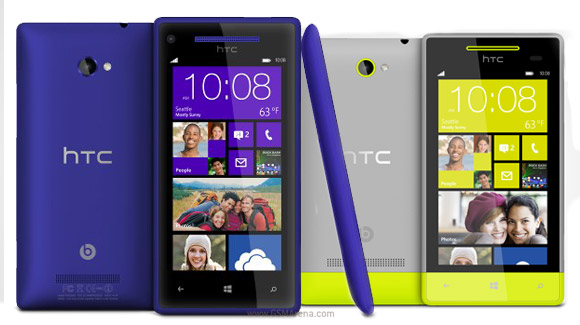
Another day, another...wait Windows Phone 8 device? That's right, two new Windows Phone 8 devices were unveiled in New York today by HTC. Sporting bright new colours, this seems to be the new style of Windows Phone 8 devices.

HTC 8X on the left, and HTC 8S on the right
WINDOWS PHONE 8X:

Looks like a Lumia, eh? The HTC 8X is the flagship of HTC's Windows Phone line and comes in blue, white, yellow and red. Similar to HTC Android phones, it comes with Beats Audio.

Inside the hood: Inside the 8X is a dual core Snapdragon S4 processor clocked at 1.5Ghz and a 1GB RAM. 16GB's of internal storage is included, with an option to have expandable storage via microSD cards of up to 32GB. An 1800mAh battery is included, enough for you to go through the day. The battery is non-removable. 

Outside the hood: The 8X has a 4.3" Super LCD 2 display with a pixel arrangement of 1280 x 720. The back camera is 8 megapixels and records at 1080p. The front-facing camera is 2.1 megapixels and also can record at 1080p.

WINDOWS PHONE 8S:

The 8S is the lower-end one of these two devices, but it is not lacking on the specification front.

Inside the hood: Inside the 8S is a single core Snapdragon S4 processor clocked at 1Ghz with 512MB of RAM. It comes with 4GB of memory, and can be expanded via microSD card of up to 32GB. A 1700mAh battery is included, but is non-removable.

Outside the hood: The 8S has a 4" Super LCD  display with a 800 x 480 resolution giving it 233ppi. The back camera is 5 megapixels capturing video at 720p. There is no front-facing camera on this device. 

Does this change your view on Windows Phone 8? If you had the choice, would you choose the 8X/8S/Lumia 820/Lumia 920?

Wednesday, September 19, 2012

What would you change about Android?

Continuing the operating system changes theme, today, we will discuss some changes I would like to see in Android. 

The implementation of skins over the stock Android overlay gets quite intrusive. Skins such as TouchWiz, Sense, and LG's UI turn the stock image, to something completely different. Comparing the skins, all three look different from each other. Placing an overlay not only is intrusive, but also slows down update rates. As Android updates are pushed out, manufacturers now need to make it compatible with their own overlay. With the time frame getting longer, this proves to be a problem with Android. For fragmentation to lower its impact, I suggest that when one turns on the phone for the first time, they are able to choose either stock Android or the manufacturers overlay. This should also be very easy to change through settings.

Pirating. I'm not a developer by any means, but pirating has got to stop. Developers put a price tag on their app to gain revenue. The developers had worked hard on these apps, and deserve a little money for the time they put into making the great app. Being open sourced, it is extremely easy to grab the .apk file and install it on your phone. Something has to be done to combat those that pirate apps.

Lag. This is a common complaint. Most of the higher-end phones do not lag as much, and much of it is fixed with the Jelly Bean update. However, only the Galaxy Nexus, Nexus S, and the Nexus 7 have Jelly Bean. No one likes lag, at least no one that I know of. Everyone enjoys getting the information at an instant. With many of the lower-end to mid-range phones, lagging is very prominent. Simply put, the processor cannot handle the amount of widgets placed on the home screen. The only way to work around this is to have less widgets, or to buy a phone with more RAM and processing speed.

What would you like to change about Android? Would you like to have less control of your device, or the ability to have a choice if your phone was based on the manufacturers overlay or AOKP?

In no way am I bashing Android, only pointing out things that annoy me as an Android user. I try not to be biased in my opinion.

Tuesday, September 18, 2012

What would you change about iOS?

iOS is not perfect, and neither is any other operating system. Over the next few days, I will discuss what I would change about iOS, and Android.


Have you ever wondered why your iPod/iPhone or iPad had certain icons that were animated and some were not? For example, the calendar app icon shows the number corresponding to the day of the month. However, the weather app icon constantly shows the same 23 degrees year round. Why not make it animated as well? Have the clock AND the weather icon animated, and we would have uniformity.

You know how on Android, the notifications show on the top? Well, why not on iOS too? I know many will start flaming and say that they are copying Android, but in all means, it is very useful. Currently, there are notifications coming in, and one does not know you get a notification unless you pull the bar down. How often will you do that? For example you're browsing the web. How would you know that someone texted you if your phone is on silent? You don't. Unless you pull down the notification bar. Annoying.

I constantly have the need to put my phone on silent during school hours, and it is essential for me to see quickly that it is on silent. When I am finished school, I like to turn my ringer sound on. I understand that on the left side of the iPhone, there is a little switch which shows ringer on and off. But what about on the screen? And how loud is the ringer exactly? It is on, but how loud? The only way to check that is to use the volume controls up and down. It would be nice to have a little icon on the screen.

Customization. The iPod/iPhone and iPad all lack in customization options. The only things you can personalize without jailbreaking is your home screen and lock screen wallpaper. I would like to be able to change the picture of certain icons. Like themes in Cydia, it would give the user a lot more freedom.

What would you like to see in iOS? What would you add, change, or remove?

On the other hand, iOS is certainly very stable, and a pleasure to use. My rant is predicated on what I would like based on what I have seen on other operating systems. In no way am I bashing iOS, only expressing some concerns for the operating system.

Monday, September 17, 2012

Another day, another Android phone. LG Optimus G officially launched


The well-rumored device, the LG Optimus G has been leaked over and over again, with top of the line specifications. Finally, it has come out, and to no surprise, with top of the line specifications.

Inside the hood: Inside the Optimus G is a powerful Qualcomm Snapdragon S4 Pro processor. It is clocked at 1.5GHz, and surprisingly a quad core. This processor is also capable of LTE network speeds. Also inside is 2GB of RAM, 32GB of onboard internal storage. It houses a 2,100mAh battery and the standard WiFi, Bluetooth 4.0, GPS, NFC, and proximity sensors. The Optimus G runs Android 4.0 with LG's custom interface.

On the outside: The Optimus G is fairly light, only 145g in weight. A| 4.7" TrueHD IPS+ display houses the front, with a 1280 x 768 resolution. On the back of the phone is a huge 13 megapixel camera and a 1.3 megapixel front-facing camera.

Are you interested in the LG Optimus G? Do you think it compares in the league of the Galaxy S3 or the One X? Let me know in the comments below.

Motorola's New Phones: Edge to Edge screen, humongous batteries and much more!

From L to R: Droid Razr HD, Droid Razr M, and Droid Razr Maxx HD
Motorola recently announced three new phones to their Droid line, the Droid Razr HD, the Droid Razr M, and the Droid Razr Maxx HD. Which one is right for you?

Droid Razr HD:
The Droid Razr HD runs Android 4.0.4 and features a "rugged" look, making it waterproof. With a 4.7" Super AMOLED display with resolution of 720x1280 (312ppi), this phone will impress. It holds a large 2530mAh battery, enough for 9 hours of talk time! Inside the hood is a Snapdragon S4 Plus clocked at 1.5Ghz. There is 16gb of onboard storage, with the ability to have expandable storage up to 32gb. The Droid Razr HD has an 8 megapixel camera with flash and an aperture size of f/2.4. A front facing camera of 1.3 megapixel is included for video chatting.

Droid Razr M:
The Droid Razr M is the first to have an edge to edge display. Running Android 4.0.4, it is also waterproof. The Droid Razr M has a 4.3" Super AMOLED screen. Despite a 4.3" screen, it is only slightly taller than the iPhone 4S. Inside is a 2000mAh battery giving you 20 days of standby time. Inside the phone is a Qualcomm Snapdragon S4 clocked at 1.5Ghz. There is 4.5Gb of onboard storage, and an expandable storage of up to 32gb. Like the Droid Razr HD, it has an 8 megapixel camera with flash and auto focus. However, the Droid Razr M only has a 0.3 megapixel front facing camera.

Droid Razr Maxx HD:
The Droid Razr Maxx HD is similar to the Droid Razr HD (hence the name), but offers a massive 3300mAh battery capable of 21 hours of talk time. 26GB of onboard storage is available to the user, with a micro SD slot capable of up to 32GB. The camera is the same as the Droid Razr HD.

All 3 phones are upgradable to Jelly Bean (4.1) by year's end.

Which of these phones is right for you? Do you need the extra battery that the Droid Razr Maxx HD packs? Or do you fancy the edge to edge display found on the Droid Razr M? Let me know below in the comments!

Sunday, September 16, 2012

What would you change on the iPhone 5?

Source: Dravide

The iPhone 5 may be an excellent phone, but no phone has no faults. For example, the Galaxy Nexus came out with an underwhelming speaker so soft, that I could never hear when my phone would ring. Or the Galaxy S3, a battery issue causing the phone to drain immediately. Heck, even the iPhone 4 came out with antenna problems, where gripping the phone "wrong" would lose signal. No phone is perfect, and the iPhone 5 is in no way, a perfect phone.

For one, I personally would have liked a change in design. Beginning with the first iPhone, it had rounded corners (let the jokes begin) and was iconic for that time. Then the iPhone 3G came, blooming with 3G capabilites and a new design. The iPhone 4 was announced, again with a dramatic change to a flat back. Now the iPhone 5, another jump in the number of the name, but the same design as the iPhone 4, but with an elongated design. Perhaps a teardrop design like many of the rumored photos and ideas, or an edge to edge screen like the Motorola Droid Razr M?

Also missing from the iPhone 5 is NFC capabilities. For those not aware of what NFC does, or is capable of doing, it essentially enables you to be able to send files wirelessly by placing two NFC capable phones together. Not only can you send files, you can also pay using your phone. With Passbook being added into iOS 6, I hardly see it being fully functional without NFC. Although NFC does not work well with a metal back, Apple could have made a plastic back.

This last one is a personal preference, but I believe that the headphone jack would work better on the top of the device. I feel that when in my pocket, it is more natural to leave the top of the phone sticking out rather than the bottom. Again, personal preference, but this is something that I would have enjoyed.

One thing that I do love, and will probably not be implemented on other phones is the ability to have a reversible charging dock. Although the iPhone 5 utilizes an 8 pin connector, and the only one to do so, they have made it reversible, making you able to put it into the slot with no difficulty. Other phones in the market use micro USB, and they have to be inserted a certain way. It's not a big thing, but I do love the option to have it reversible, and commend Apple for doing so.

So what would you change about the iPhone 5? Do you like it's aesthetic appearance? Or would you rather change some parts of iOS 6? Let me know in the comments below!

Saturday, September 15, 2012

The "revolutionary" new iPhone 5: Does it excite you?

Source: livemint
The iPhone 5 came out on Wednesday, September 12, and many flocked to their computers waiting to hear what is to come in the much anticipated iPhone 5. While the presentation was ongoing, views were mixed. Some were claiming it was beautiful, and a "must-get." Others claimed it was falling behind, catching up to its'  competitors.

RECAP:

Software: The iPhone 5 runs iOS 6, the newest operating system from Apple. Alongside, it will have a Passbook application, giving you access to coupons and deals straight to your phone. Also on iOS 6 is GPS Turn by Turn Navigation. The GPS is not powered by Google, but rather by Apple, made by scratch.

Hardware (aesthetically): The first thing that you will notice about the iPhone 5 is its screen. Apple has bumped the screen size to 4", giving it a 1136 x 640 resolution (326ppi.) It features a nano-sim card, 40% smaller than the regular micro-sim. The aesthetics of the device are mostly the same as the previous iPhone 4S, with the exception of the headphone jack now located on the bottom, and a new dock connector. Apple has changed their proprietary 30 pin connector, to a smaller, reversible 8 pin connector. (Adapters are available on sale for $29, and a full adapter with cable is on sale for $39) It weighs in at 112g with dimensions of 123.8mm x 58.6mm x 7.6 mm. Also included in the box is their new "Earphones." These "Earphones" are designed by Apple, with research done to learn the shape of one's ear. Testing with over 300 people, Apple's headphones are claimed to be a good fit.

Hardware (inside the hood): Inside the iPhone is a new A6 chip based on a dual core ARM Cortex-A15 processor. The exact mAh of the battery has not been released yet, but Apple claims it will give you 8 hours of talk time. Apple has also improved the camera, giving the iPhone 5 an 8 megapixel camera with an aperture size of f/2.4. Panorama mode has also been added, giving the iPhone 5 the ability to shoot panoramic shots at 28 megapixels. The camera shoots at 1080p at 30fps. The front facing camera is 1.2megapixels and is available to use over Facetime and Skype calls. The iPhone 5 also includes 3 microphones, cancelling any noise.

The iPhone 5 is currently available to pre-order (not available on apple.ca due to shortages) at your carriers. It will officially be released on September 21 in 16Gb ($699), 32Gb ($799), and 64Gb ($899) options in either Black and Slate or White and Silver. Note that Apple will NOT be selling unlocked devices this year at their bricks-and-mortar store. Unlocked devices will only be sold at apple.ca. The devices sold in stores will be carrier-locked.

What do you think of the iPhone 5? Are you going to pre-order the device or grab it as soon as possible? Let me know in the comments below!